

Welcome to Bamboo Propagation Info!
Bamboo news, growing tips, information and more....
A new bamboo has set flower…
Well much to my surprise, whil
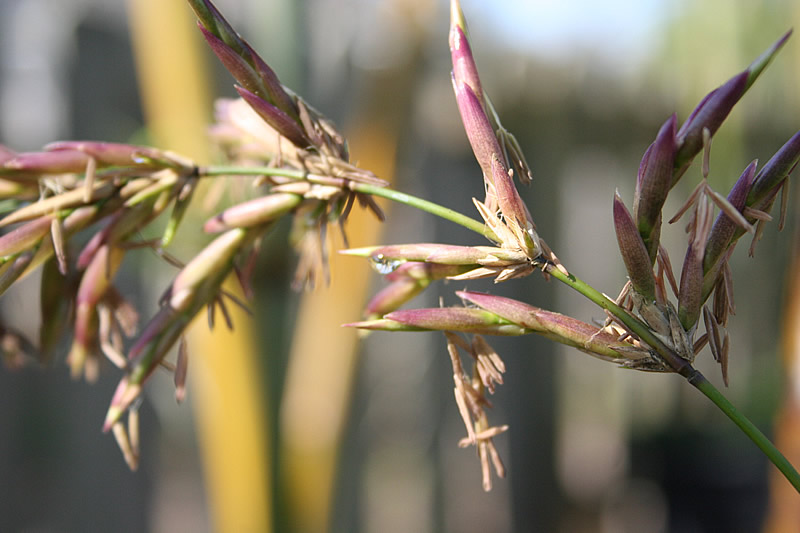
e working in the garden I noted one of my bamboos looked peculiar. Upon closer inspection I noted that this particular bamboo had started flowering! As crazy as it sounds, I thought perhaps it was perhaps due to the shock I sent the plant through, as this was culm that grew from the remnants of a clump that I had thought I had eradicated from my yard (purely for aesthetic reasons). However, a few days later, while working on the other side of yard I noted the same bamboo (I have several of each kind in my yard) was also in flower! So now I started thinking this was not just a freak accident but could be something bigger. I later sent emails to those that had received some divisions of this particular bamboo from me, and of the three that replied, one did indeed have bamboo in flower as well!
So what this means is that this is the beginning of what could be a gregarious flowering of all bamboos of this type with the same DNA strain. Typically bamboo is distributed from divisions of a mother plant, since bamboo only flowers and sets seed only once in it’s lifetime before dying (the same holds true for different types of palms as well). The flowering and seed production can last several years before the bamboo ultimately succumbs to the will of Mother Nature. However, in that time frame, the bamboo plant will have set out thousands of seed producing the next generation of it’s kind.
Propagating Clumping Bamboo Video Part 2
Well this is the second in my series on how to propagate tropical clumping bamboo. Similar to my earlier video, it shows how quick and easy it is to take multiple divisions of your bamboo using a sawzall and shovel but is slightly longer. In this particular video I took the divisions from my stand of Bambusa textilis “mutabilis”, and after stabilizing had about a 60% success rate. As explained in the video, this is partly due to the fact that some of the divisions had not branched out, so this leaves the new division relying completely on the stored energy in the rhizomes as there is no leaf mass for photosynthesis. Anyways, I hope this helps guide you to successfully propagating your clumping bamboo, and as always if you have any questions please leave a comment.
Propagating Bamboo from Seed
Bamboo is one of those unique plants that rarely flowers and thus rarely produces seed. When a bamboo does indeed set flower, it might do so for years. In the end however, after this occurs most bamboo wither away and die, with the hopes of a new generation of bamboo released in it’s seed.
So just how rare is this occurrence? Depending on species, a bamboo species will set seed once every 60 to 100 plus years. There are a few varieties though that seem to be forever in seed, such as Phyllostachys edulis, aka Moso bamboo. A quick search of eBay and Google will find many people selling seed of this famous bamboo. Buyer beware though, as bamboo seed imported in to the United States is subject to quarantine, often resulting in seed that is no longer viable. (more…)
Propagating Clumping Bamboo
Well obviously I’ve named this site Bamboo Propagation Info, so it’s only fitting that the information contained here should be about bamboo propagation. Today’s topic of discussion is how to propagate clumping bamboo.
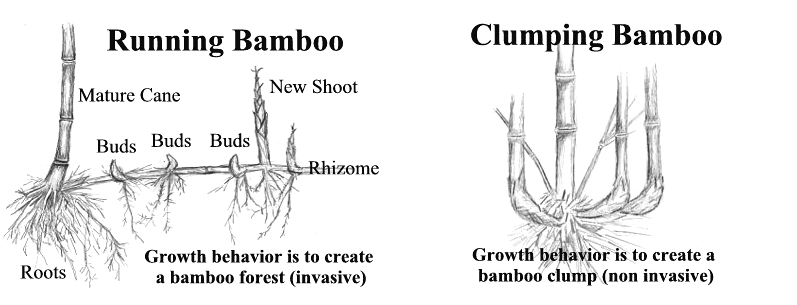
Unlike running bamboos that have rhizomes that spread far and wide, a clumping bamboo’s rhizomes stay close to the main plant, intertwining with each other to form a huge mass of roots. Depending on the variety, this root mass can go several feet underground as well. It is from this that the new shoots develop and eventually shot skywards.
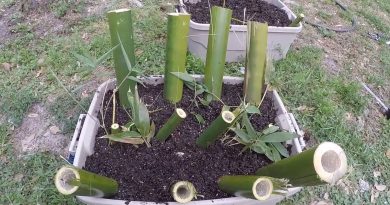
Now, this being said, one of the easiest ways to propagate a clumping bamboo is through division. This simply involves digging one or two culms from the parent plant then either potting it up or putting it directly in a new spot in your yard. If you are looking to develop a bamboo screen then this is by far the easiest and most inexpensive way to do it. As shown in my clumping bamboo propagation video, this is easily accomplished using a sawzall and shovel, though if the rhizome mass is deep and hardy a heavy duty prybar may be needed. (more…)
How To Propagate Clumping Bamboo via Division
Well it’s that time of year once again when I need to thin out my tropical clumping bamboo, paving the way for this years new culms. This also provides me with an easy way to increase my stock of bamboo, whether it is to sell or plant elsewhere in my yard. To demonstrate, I’ve made a short video tutorial on how to propagate your bamboo via division. Many people are intimidated by this, and the video will show you how quick and simple the process really is.
The Ode to Bamboo
This short paragraph quoted from “A Yankee on the Yangtze” by William Edgar Geil portrays the many uses for bamboo.
“A man can sit in a bamboo house under a bamboo roof, on a bamboo chair at a bamboo table, with a bamboo hat on his head and bamboo sandals on his feet. He can at the same time hold in one hand a bamboo bowl, in the other hand bamboo chopsticks and eat bamboo sprouts. When through with his meal, which has been cooked over a bamboo fire, the table may be washed with a bamboo cloth, and he can fan himself with a bamboo fan, take a siesta on a bamboo bed, lying on a bamboo mat with his head resting on a bamboo pillow. His child might be lying in a bamboo cradle, playing with a bamboo toy. On rising he would smoke a bamboo pipe and taking a bamboo pen, write on bamboo paper, or carry his articles in bamboo baskets suspended from a bamboo pole, with a bamboo umbrella over his head. He might then take a walk over a bamboo suspension bridge, drink water from a bamboo ladle, and scrape himself with a bamboo scraper.”
Bamboo Taxonomy
When most people think of bamboo, they immediately think of this monstrous, invasive plant that wants to take over the world! Other immediately think of bamboo as the food that the giant panda eats, while still yet others think back to their days of youth when they fished with a bamboo pole.
Anyways, no matter what visions the name bamboo incurs, and contrary to popular belief, bamboo is NOT a tree. Bamboo in fact is a member of the grass family, with at least 90 genera and over 1200 species that grow throughout the world. From tropical regions of South America, the frigid regions of Northern China to the arid regions of India, bamboo it seems grows almost anywhere.
Scientifically, bamboo can be classified as follows:
KINGDOM: Plantae
DIVISION: Magnoliophyta
CLASS: Liliopsida
SUBCLASS: Commelinidae
ORDER: Cyperales
FAMILY: Poaceae
SUBFAMILY: Bambusoideae
TRIBE: Bambuseae
SUBTRIBE: bambusinae
In addition to that, bamboo is then broken down into two categories based on it’s rhizome structure, or roots. Leptomorph bamboos are your typical running bamboo, and pachymorph bamboos are your clumping bamboos. Bamboos are also categorized based on their species type, such as Bambusa, Chusquea, Dendrocalamus, Fargesia, Phyllostachys, Pleioblastus, Pseudosasa, and Sasa to name a few.
The various bamboo varieties also display a variety of colors, from brilliant greens to alternating yellow and green strips on the culms to variagated leaves, bamboo can be a striking speciman in any landscape. Bamboo also vary greatly in size, some barely growing more than six inches tall to some that grow more thanone hundred feet tall, as well as varying widths, from the size of a pencil to more than eight inches in diameter!